Landscape

Tuesday, 26 August 2014
Google Classroom
I'm excited about using Google Classroom. The design is simplistic and easy to use, providing quick access to particular classes. I like how it automatically creates assignment/class folders within google drive. The announcement section looks promising as a way of developing teacher/student dialogue (particularly useful for quieter students). Can't wait to try this out in September...

Friday, 8 August 2014
Book Review - Bad Science by Ben Goldacre

This is a fascinating book into the world of research and statistics. Goldacre looks at topics including Homeopathy, MMR Vaccines and Drug Companies and investigates the flawed medical trials and the problems with media interpretation. For teachers, there is also a section on the folly of Brain Gym.
As a Maths teacher, the book is extremely useful becuase it provides great insight in to modern techniques and how to correctly carry out Medical trials and Research, by often highlighting misleading methods and statistics. It looks in details at topics such as blind testing, regression to the mean, placebo effects, etc. This book would be particularly useful to run with the new Core maths qualification at post 16.
I would highly recommend this book to not just maths and science teachers, but to everyone within education. It highlights the need for a solid research base in education and the need for greater knowledge in this area. Fads, like Brain Gym, not only damage the education of our students but are a huge waste of money and resources.
See more at badscience.net and section for teachers.
Thursday, 7 August 2014
Book Review - Why Don't Students Like School by Daniel T. Willingham
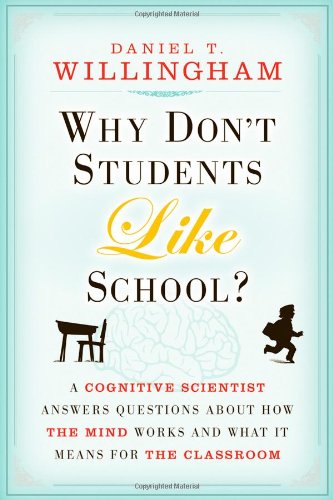
Willingham has written a thoughtful and insightful book about cognitive science. He describes current understanding of how the mind works and the possible impact of this research on life in schools and classrooms.
"The mind is at last yielding its secret to persistent scientific investigation. We have learned more about how the mind works in the last twenty-five years than we did in the previous twenty-five hundred."
The main findings from this book indicate the importance of factual knowledge to children's development, "thinking well requires known facts". Willingham discusses the importance of working memory and uses the imagery of allocated slots. It is important not to overburden the working memory. To achieve this, teachers need to organise deliberate practice for their students. This must be maintained over time and can be folded into more advanced skills. This moves knowledge from working memory to long term memory and avoids overload by becoming automatic (e.g.like driving a car).
I agree with the important message though that drives through this book, that we should make students think deeply, but in order to achieve this, shallow learning and practice is sometimes needed. Unfortunately in recent times in the UK this has been ignored in pursuit of fluff, show lessons that are thought to impress OFSTED, but do not aid the overall development of students and often distract students from thinking about what they are supposed to. Practise automatices knowledge from working memory to long term memory and allows the brain to work more efficiently and fluidly. The idea of conceptual understanding is not rubbished but he promotes a balanced approach between procedural and conceptual development. Connections between topics and previous learning are also important because they reduce the stress on working memory and develop proficiency.
The ideas of hooks are also promoted. Interestingly, it is suggested to try these in the middle of the lesson rather than the usual start or end. Hooks are very useful in allowing the brain to make connections and help to develop a deeper understanding of topics.
He states we should, "strive for deep understanding in your students, not the creation of new knowledge" (that will come later). The vast majority of top mathematicians, scientists etc. have got there because they have developed core knowledge and then have worked hard to excel in their particular field. I have also considered it strange how some of the highest academics criticise the path to how they have excelled. It is like a walker crossing a log on a fast moving stream and then kicking it away so others cannot cross in the same way. This is an important message and one that slightly differs from other books I have read - particularly in the field of maths education, where the message is to try to get students to think like elite mathematicians. Often this has happened through the promotion of calculators or more recently WolframAlpha as a substitute for basic knowledge. Although these products are useful, ignoring the basics does not benefit students in the long term. Again it is important to emphasise, higher order thinking is important but must not be done at the expense of basic skills that underpin subjects.
Willingham's chapter about intelligence is very similar to the work completed by Dweck. (See previous post about Grit and a Growth Mindset). Intelligence although partly dependent on genetics and environment is not fixed. "Intelligence can be changed through sustained hard work". This message is extremely important to us as educators. For if it was fixed what would be the point of education? This has particular resonance in mathematics in the Western World where often there is a stigma around the subject and people strongly believe they simply cannot do it because of some inherited fault. Willingham highlights the folly of this idea and with hard work everyone can improve.
At the heart of teaching is to try to make students think. This book provides powerful insight in how to achieve this.
Book Review - 1089 + All That by David Acheson

David Acheson has written an excellent little book about a journey into mathematics. This book is an ideal read for any teacher or student. It is an excellent holiday read to maintain and top up mathematical knowledge. 1089 is written in short passages, making it easy to read but doesn't shy away from some relatively complicated mathematics and contains some gems of mathematical insight. Amazingly, this small book deals with a whole range of topics from pi to chaos theory.
Thursday, 10 July 2014
Online Markbook
Online Markbook
I have been developing my markbook online. See a blank version here. I prefer an online markbook to a paper copy because it allows me to edit and move things around easily. I have a separate markbook for each class.

I have been developing my markbook online. See a blank version here. I prefer an online markbook to a paper copy because it allows me to edit and move things around easily. I have a separate markbook for each class.
The markbook has been divided into 11 sections: Seating Plan, Information, SEND, Marking, Homework, Mymaths/Sam Learning, Assessment, Intervention, Medium Term Plan, Postcards and Parents Evening. I don't record a register on the markbook because the data is collected elsewhere. Data is also collected separately centrally on a department tracking sheet. Therefore, the purpose of this markbook is to allow me to stay on top of classes by providing me with information needed to teach and most importantly to make notes so I can monitor individuals and classes as a whole.
Most of the sections are self explanatory. This year, I have added an Intervention section. In this section, I record all interventions for each of my classes. Examples of these include behaviour incidents, contact with parents or other members of staff, any concerns or worries I have about individuals, positive news/rewards. The outcomes is crucial to this intervention page. Here I record what has happened since the intervention eg has an individual students behaviour/attitude/performance improved? I have found this to be extremely useful, because it allows me to look back and see how individuals have responded and hopefully improved. Every half-term, I also write a quick class report. This allows me to reflect on the progress of the class and individuals.
For the marking and homework, I use a very simple colour scheme. Green for good, Red for bad. Over time this provides a quick visual of class and individual performance.
My online Markbook is created on Google Sheets. Sharing this with other members of my department or SLT is easy. Google Drive has substantially improved in recent years. It is very easy and intuitive to create and save files. The filing system is now clear and structured, allowing you to find files quickly. The big advantage of Google Drive is I can access it anywhere. Files can be viewed and edited on my phone and tablet, aswell as any computer. Plus, I can't lose it!
Next year, I want to develop my recording of assessment and progress. I'm looking to move towards analogue data per topic and using various sources to record data (e.g. quizzes, diagnostic questions, end of term tests, homework).
My markbook is designed to be simple to use and easily adapted to individual needs. It is not the markbook to end all markbooks and is a work in progress. Feel free to use or adapt if you want. (Press File, Make a copy...)
Wednesday, 9 July 2014
Reading List for New Maths Teacher
I was asked recently what I thought would be a suitable reading list for a new UK Maths teacher. Below is my list. Have I missed anything out?
General Teaching:
Mathematics:
General Teaching:
- "Teach Like a Champion", Doug Lemov
- "Mindset", Carol Dweck
- "Why Don’t Students Like School", Daniel T Willingham
- "An Ethic of Excellence", Ron Berger
- "The Hidden Lives of Learners", Graham Nuthall
- "Visible Learning and the Science of How We Learn", John Hattie
- "100 Ideas for Secondary Teachers", Ross Morrison-McGill
- "Teacher’s Tookit", Paul Ginnis
- "Trivium 21C", Martin Robinson
- "Adapt", Tim Harford
- "The Secret of Literacy", David Didau
- "The Behaviour Guru", Tom Bennett
- "How to Teach", Phil Beadle
- "The Perfect (Ofsted) Lesson", Ian Gilbert
- "Teacher Proof", Tom Bennett
- "Getting the Buggers to Behave", Sue Cowley
- "The Lazy Teacher's Handbook", Jim Smith
- "How Children Learn", John Holt
Mathematics:
- "The Elephant in the Classroom", Jo Boaler
- "Alex’s Adventures in Numberland", Alex Bellos
- "Taming the Infinite", Ian Stewart
- "Murderous Maths" series by Kjartan Poskitt
- "The Perfect Maths Lesson", Ian Loynd
- "Adapting and Extending Secondary Mathematics Activites", Stephanie Prestage & Pat Perks
- Collection of Professional Development Materials for Maths Teachers by Mark McCourt at Emaths
- Cockcroft Report 1982
- "Getting the Buggers to Add Up", Mike Ollerton
- "Key Ideas in Teaching Maths - Research-based Guidelines for ages 9-19", Anne Watson, Keith Jones, Dave Pratt
- "Nix the Tricks", Tina Cardone and MTBoS
- "How Children Learn Mathematics", Pamela Liebeck
- Collection of Publications by Professor Malcolm Swan
- "Children Discover Arithmetic", Catherine Stern
- "Understanding Mathematics for Young Children", Derek Haylock
- "1089 and All That", David Acheson
- Debates in Mathematics Education, edited by Dawn Leslie and Heather Mendick, for the more reflective practitioner
Saturday, 5 July 2014
Collaborative/Cooperative Learning
"Collaborative or cooperative learning can be defined as learning tasks or activities where students work together in a group small enough for everyone to participate on a collective task that has been clearly assigned. This can be either a joint task where group members do different aspects of the task but contribute to a common overall outcome, or a shared task where group members work together throughout the activity. Some collaborative learning approaches also get mixed ability teams or groups to work in competition with each other, in order to drive more effective collaboration."
(Education Endowment Foundation)
My Practice
This year, I have begun to develop my practice specifically towards cooperative learning. In my classroom, students work together in small 'pods' (3 or 4 students) where the goal is to help and support each other to develop their learning and understanding.

Within each pod, I try to mix gender, ability and other factors. When needed, students have changed pods during the year. For a small minority students, it has been more of a challenge to settle them to work collaboratively within a pod and to find the most effective pod for them to work in. I have found older students are more likely to create a stable and effective pod which stays in tact for the whole year. I would suggest this is probably because their friendships with other students is more secure. Younger students are generally happy to work within pods, but these have to be altered more frequently throughout the year to achieve balance and harmony within the class.
I have not imposed a competitive element into my system yet. I am considering it carefully for next year and I'm thinking of trialing it with my KS3 classes (11-14). I am aware of the importance of getting this right so will need to do more research over the next couple of months.
I actively encourage students to work closely within their pods. Specific tasks are created to encourage discussion within the pod. When an individual seeks help from me, I tend to talk and involve the pod as a group, thus encouraging them to work and think as a team. This often ensures quieter members of the pod also get support. On this note, both introvert and extrovert students seem to work well within this system and neither type dominates. I encourage higher ability members to support their pod with explicit praise, both verbal and written.
Evidence
"Evidence about the benefits of collaborative learning has been found consistently for over 40 years and a number of research studies have been completed. In addition to direct evidence from research into collaborative learning approaches, there is also indirect evidence where collaboration has been shown to the effectiveness of other approaches such as mastery learning or digital technology. It appears to work well for all ages if activities are suitably structured for learners’ capabilities and positive evidence has been found across the curriculum."
(Education Endowment Foundation)
Reflections
Collaborative/Cooperative learning has helped to develop a positive atmosphere within my classroom. I have found the vast majority of students work well within the pods and this has helped to develop independent learning skills as they tend to ask each other first and only ask me if confusion or uncertainty remains. To help students, I move between pods, rather than individuals, which is more time-effective. This strategy seems to work very naturally with Mathematics.
For more information:
(Education Endowment Foundation)
My Practice
This year, I have begun to develop my practice specifically towards cooperative learning. In my classroom, students work together in small 'pods' (3 or 4 students) where the goal is to help and support each other to develop their learning and understanding.
(source: National Wildlife Federation)
Within each pod, I try to mix gender, ability and other factors. When needed, students have changed pods during the year. For a small minority students, it has been more of a challenge to settle them to work collaboratively within a pod and to find the most effective pod for them to work in. I have found older students are more likely to create a stable and effective pod which stays in tact for the whole year. I would suggest this is probably because their friendships with other students is more secure. Younger students are generally happy to work within pods, but these have to be altered more frequently throughout the year to achieve balance and harmony within the class.
I have not imposed a competitive element into my system yet. I am considering it carefully for next year and I'm thinking of trialing it with my KS3 classes (11-14). I am aware of the importance of getting this right so will need to do more research over the next couple of months.
I actively encourage students to work closely within their pods. Specific tasks are created to encourage discussion within the pod. When an individual seeks help from me, I tend to talk and involve the pod as a group, thus encouraging them to work and think as a team. This often ensures quieter members of the pod also get support. On this note, both introvert and extrovert students seem to work well within this system and neither type dominates. I encourage higher ability members to support their pod with explicit praise, both verbal and written.
Evidence
"Evidence about the benefits of collaborative learning has been found consistently for over 40 years and a number of research studies have been completed. In addition to direct evidence from research into collaborative learning approaches, there is also indirect evidence where collaboration has been shown to the effectiveness of other approaches such as mastery learning or digital technology. It appears to work well for all ages if activities are suitably structured for learners’ capabilities and positive evidence has been found across the curriculum."
(Education Endowment Foundation)
Reflections
Collaborative/Cooperative learning has helped to develop a positive atmosphere within my classroom. I have found the vast majority of students work well within the pods and this has helped to develop independent learning skills as they tend to ask each other first and only ask me if confusion or uncertainty remains. To help students, I move between pods, rather than individuals, which is more time-effective. This strategy seems to work very naturally with Mathematics.
For more information:
Subscribe to:
Posts (Atom)