Landscape

Showing posts with label Teaching Strategies. Show all posts

Saturday, 24 October 2015

GEG UK


My head hurts. It's in a spin. It has nothing to do with alcohol...

Yesterday, I went to Google HQ in London for a meeting with GEG UK (Google Education Group) organised by +Ben Rouse . Firstly, I can confirm, people actually play ping pong at Google HQ.

Why does my head hurt? Basically, it's 10x Thinking and it's now bursting with new ideas. How can we make the world a better place? How can we improve education where the teachers are unshackled from administration and given the time and resources to focus on teaching? How can we massively reduce costs for schools, allowing them to divert funds from waste to things that can make the difference? How can we improve the lives of our students and provide them with efficient working and thinking strategies and skills right now?

Is Google the magic bullet?

... uhm... not sure. However, it does have an amazing set of free products in GAFE. Then there are the people working around the fringes of Google, not employed by Google, but using its products and philosophy to drive through changes.

Okay - for the next bit I'm going to write about Google products etc. If you're still carrying pen drives around your neck or constantly sending Word docs or Excel sheets (or worse still printing them off and handing them out) that others struggle to collaborate with you, then you might want to stop reading now...

Latest Google Products
In 2014, Google 'allowed' access to the cloud and introduced Google Drive. 2015 - the big driving force has been Google Classroom and low cost devices. Now for the future - empowering teachers through CPD programmes and amazing tools - one in particular that looks amazing is Expeditions (think of a more integrated Google Cultural Institute).


Certification and Google Training
Personally, I am at the beginning of this journey. I have completed the fundamentals training for Level 1 Certified Educator and I am hoping to do the exam this week. I know for many colleagues the thought of doing exams can be very daunting, scary etc. I personally haven't done one for years - I sort of did a test when I did my 3 day first aid course, but the last sit down one was in Uni. However, these are low cost exams (not just financially) but their impact if you fail. So, I've decided to just go for it and see where it takes me.

Implementation
Quite simply, Google products can reduce costs significantly by allowing people to collaborate and communicate effectively, Put simply by +Mark House , it's cuts down nonsense. (At this point, I must declare an interest because I've worked with Mark for years at the same school). The focus is on reducing teacher workload by marginal gains (which worked for Clive Woodward's England rugby team in 2003 and the David Brailsford's GB/Sky cycling team) to allow them to focus on the most important part of the job, teaching. Think of all the bits of paper, emails, meetings, you received and responded to over the last couple of weeks. Were any of them nonsense?

Getting SMT to sign up is vital. One of the biggest moves in our school was when the Principal (Headteacher) swapped his computer in his office for a chromebox and went all in - this encouraged and made it necessary for others to follow.


+Oli Trussell talk on BYOD (bring your own device) was very informative. When every student has a device, schools can save time and money by using Google Classroom instead of physical textbooks and printed worksheets. However, there are pitfalls:

Don’t:
  • Proxy servers
  • Expect it to just work
  • 1 person to implement
  • Undervalue
Recommendations:
  • Get Chromebooks! (if you can…)
  • Allow BYOD to support/enhance
  • Get ‘Critics’ on board quickly!
  • Train often (students and teachers)

I love the idea of Uckfield Community Technical School +Jeanette O'Connor of getting expert students to help with the CPD support and training of not just other students but staff as well. BYOD chromebooks looks the way to go.


Pedagogy and Tools

And very quickly - some excellent ideas shared by +Dean Stokes


Best slam has to be x-ray goggles - I can now win at everything!

In my opinion, you cannot be an 'Outstanding' teacher if you are surrounded by 'weak' teachers. Who can you inspire?

And that was GEG UK Live 2015. Now you can see why my head hurts. :-)

Tuesday, 16 December 2014

I saw that on a Numberphile video...

Last week, I was listening to a couple of year 7s discussing maths in class when I heard one of them say, "I saw that on a Numberphile video..." This was one of the highlights of my term because the video in question was not one I had promoted to the class. This term, I have introduced Google Classroom into my teaching and one of the excellent uses is to subtly promote Numberphile and other fantastic mathematical resources.

I'm going to go out on a limb here. I think Numberphile is the most inspirational resource I have seen for Mathematics. By using youtube, Numberphile has opened the door to complex Maths that to this point remained hidden deep and difficult to find for the vast majority of people. It is ground-breaking and has the potential to be as influential  as Martin Gardner's work in bringing maths to the masses and deepening understanding of Mathematics beyond basic numeracy. It goes way beyond other attempts to open up mathematics, such as Johnny Ball in the UK, who promoted mathematics in an entertaining manner, but failed to look deeply and demystify the subject. Numberphile embraces the complexity of mathematics and challenges the grey cells, and with the creation of Numberphile 2 (with its focus on the 'hard' maths) this looks to continue strongly.

A big thank you to Brady Haran (producer, editor and thoughtful interviewer of the Numberphile videos) and the inspirational contributors, including the fantastic and amusing Dr James Grime and Matt Parker (two of the main contributors to the channel). Dr James Grime has his own youtube channel singingbanana, which is full of mathematical gems. Matt Parker has been touring the country with the best show ever, Festival of the Spoken Nerd, his talk on spreadsheets zooms into the heart of computing and mathematics.

Other excellent youtube channels for maths include:
Vi Hart
Smarter Every Day (although there is some Science in this one as well!)

Thursday, 4 December 2014

Khan Academy


I used Khan Academy for the first time with one of my teaching groups today. I have previously explored Khan Academy, from a student's point of view, trying out different tasks etc (I would strongly advise you do this before hand) and felt the time was now right to become a 'coach' and investigate its usefulness within the classroom. 

The group I chose was a GCSE retake group. I had managed to permanently book an IT room for once a week with this group and this made an opportune moment to experiment. I was pleasantly surprised how well the lesson went. It was very easy to set up a Khan Academy Classroom. I had already established a Google Classroom, so I highlighted every student and clicked to email them, then copied their email addresses and pasted this into Khan Academy. It took a couple of minutes to create a classroom and then for students to join by clicking the link sent to them via email.. 

I didn't set up any particular tasks or missions but invited the class to focus on the foundation area of Mathematics. With little instruction, students were quickly able to complete tasks. They became motivated by the points and awards. Soon this became competitive with some students. All students engaged and were on task. Students began asking for help when needed - I haven't yet started emphasising the online video support, but will start doing that from next lesson. Some students who had been less motivated suddenly started working very well. The class lost track of time and worked into their break time and at the end of the day, a student emailed to see if he was number one (as he had been working on tasks during his lunchtime). I will see if this level of enthusiasm persists. Students seem to enjoy not only the competitive side but the independence Khan Academy gave them.

The data on students and classes is very useful. Progress of the class is easily monitored time and this can be varied. Putting a leader-board on the interactive whiteboard inspired some students to be competitive - students worked hard to be at the top and to avoid the bottom place. Individual data was also useful to see where students were struggling and also what they were able to do. Generally, I think students found it motivating that they were able to complete easier tasks, but this will need to be monitored to ensure they can complete more complex tasks needed for their examinations.

My next step is to create a playlist of topics that will be suitable for my students and enable me to focus their attention on particular units. I have quickly set up Khan Academy Classrooms for my other groups, but are not planning to use it within the classroom, but to encourage them to practise their maths skills in their own time. I will be curious to see how it will work in this context.

Khan Academy provides clear and comprehensive support for teachers to help them on this journey - Khan Academy Support Materials

Saturday, 4 October 2014

Google Classroom - Month One.

This September, I have been using Google Classroom. The story so far...

Google Classroom is very easy to use. It was relatively straightforward to invite students or get themselves to join the classroom and as they become used to the technology the process will become natural and simple.

I currently am a strong advocate of mymaths. It provides a comprehensive package for all school aged students. The user interface becomes more complicated post-16 and I use it less with A-level groups. However, for the majority of students it provides an efficient and straight forward method of completing homework. Firstly, you cannot lose it. Secondly, if you are stuck (including parents) it provides useful online lessons. Next, it marks work and provides instant feedback. Then crucially, it allows students to have further attempts (modifying the homework in the process). As a teacher, it provides me with spreadsheets which allow me to see how individual students/classes are performing on particular topics and links this with the old level descriptors and GCSE grades (soon to be old). This data can be easily used for report writing and for discussing with students and parents.

So why the need for Google Classroom. Currently, I am mostly using Google Classroom as a noticeboard. I use it to keep students up to date with current homework tasks and I use it to extend their current understanding and deepen their knowledge of mathematics by posting videos such as this from Dr James Grime:


I am currently experimenting with creating a questionnaire and then posting this on Google Classroom. I created a questionnaire to find out more information about the food students ate. Forms does not directly link to Classroom (yet). Although the Form, told me who had completed it, this was not then updated to the assignment on Google Classroom. I'm waiting for all the results to be in and looking forward to analysing the results. Update findings in next review of Google Classroom.


Tuesday, 26 August 2014

Google Classroom

I'm excited about using Google Classroom. The design is simplistic and easy to use, providing quick access to particular classes. I like how it automatically creates assignment/class folders within google drive. The announcement section looks promising as a way of developing teacher/student dialogue (particularly useful for quieter students). Can't wait to try this out in September...


Promotional video by Google


Google Classroom Teacher and Student View by +Roger Nixon

Google Classroom Community on Google+


Thursday, 7 August 2014

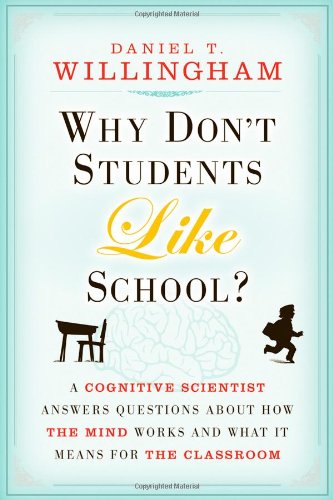
Book Review - Why Don't Students Like School by Daniel T. Willingham


Willingham has written a thoughtful and insightful book about cognitive science. He describes current understanding of how the mind works and the possible impact of this research on life in schools and classrooms. 

"The mind is at last yielding its secret to persistent scientific investigation. We have learned more about how the mind works in the last twenty-five years than we did in the previous twenty-five hundred."

The main findings from this book indicate the importance of factual knowledge to children's development, "thinking well requires known facts".  Willingham discusses the importance of working memory and uses the imagery of allocated slots. It is important not to overburden the working memory. To achieve this, teachers need to organise deliberate practice for their students. This must be maintained over time and can be folded into more advanced skills. This moves knowledge from working memory to long term memory and avoids overload by becoming automatic (e.g.like driving a car).

I agree with the important message though that drives through this book, that we should make students think deeply, but in order to achieve this, shallow learning and practice is sometimes needed. Unfortunately in recent times in the UK this has been ignored in pursuit of fluff, show lessons that are thought to impress OFSTED, but do not aid the overall development of students and often distract students from thinking about what they are supposed to. Practise automatices knowledge from working memory to long term memory and allows the brain to work more efficiently and fluidly. The idea of conceptual understanding is not rubbished but he promotes a balanced approach between procedural and conceptual development. Connections between topics and previous learning are also important because they reduce the stress on working memory and develop proficiency. 

The ideas of hooks are also promoted. Interestingly, it is suggested to try these in the middle of the lesson rather than the usual start or end. Hooks are very useful in allowing the brain to make connections and help to develop a deeper understanding of topics.

He states we should, "strive for deep understanding in your students, not the creation of new knowledge" (that will come later). The vast majority of top mathematicians, scientists etc. have got there because they have developed core knowledge and then have worked hard to excel in their particular field. I have also considered it strange how some of the highest academics criticise the path to how they have excelled. It is like a walker crossing a log on a fast moving stream and then kicking it away so others cannot cross in the same way. This is an important message and one that slightly differs from other books I have read - particularly in the field of maths education, where the message is to try to get students to think like elite mathematicians. Often this has happened through the promotion of calculators or more recently WolframAlpha as a substitute for basic knowledge. Although these products are useful, ignoring the basics does not benefit students in the long term. Again it is important to emphasise, higher order thinking is important but must not be done at the expense of basic skills that underpin subjects.

Willingham's chapter about intelligence is very similar to the work completed by Dweck. (See previous post about Grit and a Growth Mindset). Intelligence although partly dependent on genetics and environment is not fixed. "Intelligence can be changed through sustained hard work". This message is extremely important to us as educators. For if it was fixed what would be the point of education? This has particular resonance in mathematics in the Western World where often there is a stigma around the subject and people strongly believe they simply cannot do it because of some inherited fault. Willingham highlights the folly of this idea and with hard work everyone can improve.

Willingham's last chapter focuses on teacher development. He believes teachers need to deliberately practice to improve. He provides a comprehensive approach to this using video, teacher feedback and other ideas. I liked the simplicity of an idea earlier in the book where two skills of teaching were highlighted: organisation and relationships. I look forward to trying out some of these ideas in the new academic year.

At the heart of teaching is to try to make students think. This book provides powerful insight in how to achieve this.

Thursday, 10 July 2014

Online Markbook

Online Markbook

I have been developing my markbook online. See a blank version here. I prefer an online markbook to a paper copy because it allows me to edit and move things around easily. I have a separate markbook for each class.


The markbook has been divided into 11 sections: Seating Plan, Information, SEND, Marking, Homework, Mymaths/Sam Learning, Assessment, Intervention, Medium Term Plan, Postcards and Parents Evening. I don't record a register on the markbook because the data is collected elsewhere. Data is also collected separately centrally on a department tracking sheet. Therefore, the purpose of this markbook is to allow me to stay on top of classes by providing me with information needed to teach and most importantly to make notes so I can monitor individuals and classes as a whole.

Most of the sections are self explanatory. This year, I have added an Intervention section. In this section, I record all interventions for each of my classes. Examples of these include behaviour incidents, contact with parents or other members of staff, any concerns or worries I have about individuals, positive news/rewards. The outcomes is crucial to this intervention page. Here I record what has happened since the intervention eg has an individual students behaviour/attitude/performance improved? I have found this to be extremely useful, because it allows me to look back and see how individuals have responded and hopefully improved. Every half-term, I also write a quick class report. This allows me to reflect on the progress of the class and individuals. 

For the marking and homework, I use a very simple colour scheme. Green for good, Red for bad. Over time this provides a quick visual of class and individual performance.

My online Markbook is created on Google Sheets. Sharing this with other members of my department or SLT is easy. Google Drive has substantially improved in recent years. It is very easy and intuitive to create and save files. The filing system is now clear and structured, allowing you to find files quickly. The big advantage of Google Drive is I can access it anywhere. Files can be viewed and edited on my phone and tablet, aswell as any computer. Plus, I can't lose it! 

Next year, I want to develop my recording of assessment and progress. I'm looking to move towards analogue data per topic and using various sources to record data (e.g. quizzes, diagnostic questions, end of term tests, homework).

My markbook is designed to be simple to use and easily adapted to individual needs. It is not the markbook to end all markbooks and is a work in progress. Feel free to use or adapt if you want. (Press File, Make a copy...)

Wednesday, 9 July 2014

Reading List for New Maths Teacher

I was asked recently what I thought would be a suitable reading list for a new UK Maths teacher. Below is my list. Have I missed anything out?

General Teaching:

  • "Teach Like a Champion", Doug Lemov 
  • "Mindset", Carol Dweck 
  • "Why Don’t Students Like School", Daniel T Willingham 
  • "An Ethic of Excellence", Ron Berger 
  • "The Hidden Lives of Learners", Graham Nuthall 
  • "Visible Learning and the Science of How We Learn", John Hattie 
  • "100 Ideas for Secondary Teachers", Ross Morrison-McGill 
  • "Teacher’s Tookit", Paul Ginnis 
  • "Trivium 21C", Martin Robinson 
  • "Adapt", Tim Harford 
  • "The Secret of Literacy", David Didau 
  • "The Behaviour Guru", Tom Bennett 
  • "How to Teach", Phil Beadle 
  • "The Perfect (Ofsted) Lesson", Ian Gilbert 
  • "Teacher Proof", Tom Bennett 
  • "Getting the Buggers to Behave", Sue Cowley
  • "The Lazy Teacher's Handbook", Jim Smith
  • "How Children Learn", John Holt
Shaun Allison has created an excellent CPD video library


Mathematics:

  • "The Elephant in the Classroom", Jo Boaler 
  • "Alex’s Adventures in Numberland", Alex Bellos 
  • "Taming the Infinite", Ian Stewart 
  • "Murderous Maths" series by Kjartan Poskitt
  • "The Perfect Maths Lesson", Ian Loynd
  • "Adapting and Extending Secondary Mathematics Activites", Stephanie Prestage & Pat Perks 
  • Collection of Professional Development Materials for Maths Teachers by Mark McCourt at Emaths
  • Cockcroft Report 1982 
  • "Getting the Buggers to Add Up", Mike Ollerton
  • "Key Ideas in Teaching Maths - Research-based Guidelines for ages 9-19", Anne Watson, Keith Jones, Dave Pratt
  • "Nix the Tricks", Tina Cardone and MTBoS
  • "How Children Learn Mathematics", Pamela Liebeck
  • Collection of Publications by Professor Malcolm Swan
  • "Children Discover Arithmetic", Catherine Stern
  • "Understanding Mathematics for Young Children", Derek Haylock
  • "1089 and All That", David Acheson
  • Debates in Mathematics Education, edited by Dawn Leslie and Heather Mendick, for the more reflective practitioner

Saturday, 5 July 2014

Collaborative/Cooperative Learning

"Collaborative or cooperative learning can be defined as learning tasks or activities where students work together in a group small enough for everyone to participate on a collective task that has been clearly assigned. This can be either a joint task where group members do different aspects of the task but contribute to a common overall outcome, or a shared task where group members work together throughout the activity. Some collaborative learning approaches also get mixed ability teams or groups to work in competition with each other, in order to drive more effective collaboration."
(Education Endowment Foundation)

My Practice

This year, I have begun to develop my practice specifically towards cooperative learning. In my classroom, students work together in small 'pods' (3 or 4 students) where the goal is to help and support each other to develop their learning and understanding.


Within each pod, I try to mix gender, ability and other factors. When needed, students have changed pods during the year. For a small minority students, it has been more of a challenge to settle them to work collaboratively within a pod and to find the most effective pod for them to work in. I have found older students are more likely to create a stable and effective pod which stays in tact for the whole year. I would suggest this is probably because their friendships with other students is more secure. Younger students are generally happy to work within pods, but these have to be altered more frequently throughout the year to achieve balance and harmony within the class.

I have not imposed a competitive element into my system yet. I am considering it carefully for next year and I'm thinking of trialing it with my KS3 classes (11-14). I am aware of the importance of getting this right so will need to do more research over the next couple of months.

I actively encourage students to work closely within their pods. Specific tasks are created to encourage discussion within the pod. When an individual seeks help from me, I tend to talk and involve the pod as a group, thus encouraging them to work and think as a team. This often ensures quieter members of the pod also get support. On this note, both introvert and extrovert students seem to work well within this system and neither type dominates. I encourage higher ability members to support their pod with explicit praise, both verbal and written.

Evidence

"Evidence about the benefits of collaborative learning has been found consistently for over 40 years and a number of research studies have been completed. In addition to direct evidence from research into collaborative learning approaches, there is also indirect evidence where collaboration has been shown to the effectiveness of other approaches such as mastery learning or digital technology. It appears to work well for all ages if activities are suitably structured for learners’ capabilities and positive evidence has been found across the curriculum."
(Education Endowment Foundation)

Reflections

Collaborative/Cooperative learning has helped to develop a positive atmosphere within my classroom. I have found the vast majority of students work well within the pods and this has helped to develop independent learning skills as they tend to ask each other first and only ask me if confusion or uncertainty remains. To help students, I move between pods, rather than individuals, which is more time-effective. This strategy seems to work very naturally with Mathematics.

For more information: