Landscape

Showing posts with label Educational Research. Show all posts

Saturday, 4 October 2014

ResearchED National Conference London 6/9/14


The National ResearchED Conference this year was held at Raine's Foundation School,

The day began with an historical journey into education from when Raine's was established to the present day, by the present Headteacher, John Bradshaw. The difficulties faced over the years remain remarkably similar. Tom Bennett followed up, by trying to ignite a polite rebellion against top-down CPD and encouraging teachers to have a healthy relationship with research - cautious and curious.

One of the best things about ResearchED conferences is you get a choice of speakers (although this can lead to a bit of a headache deciding who to go to see). So first up, Dr Jonathan Sharples from The Education Endowment EEF. Jonathan talked about current research projects and advocated research champions within every school. He provided guidance on how to perform your own research:

1. Decide what you want to achieve
2. Identify possible solutions
3. Give it the best chance of success
4. Did it work?
5. Securing and spreading change.
And back to number one...


Next, the popular Dylan Wiliam (name spelt correctly!). Dylan's lecture was the provocatively titled, "Why teaching will never be a research-based profession and why that's a good thing". His first argument was that the cupboard was bare in relation to ed-research. He highlighted the difficulty of establishing causality and only lucky experiments get published (i.e. those who show a correlation, especially if it is the positive/negative result the author wished to see).

Following Dylan, I stayed in the beautiful old school hall to watch Prof. Robert Coe. Robert started with a cautionary note about offering teachers feedback after lesson observations. He emphasised, "What you think is good teaching may not be". Just because a certain way of teaching works for one person does not mean this can be transferred to another teacher, teaching a different class. Feedback to teachers must be:

  1. based on best evidence
  2. reflect diversity of teachers
  3. include protocols for demonstrating when they are met
To improve teaching a better understanding of evidence is needed that is based on research.

Phillipa Cordingly (CUREE) has researched exceptional schools in challenging circumstances and her compared them to other schools to try to discover why they are exceptional. Her comprehensive findings can be downloaded here.

Amanda Spielman (OFQUAL) provided useful insight and data into the examination process. She discusssed the pros and cons of the current examination system. People hugely underestimate variability in year-to-year exams. This can be as much as 12% in mathematics (which is generally straight forward to mark) and not surprising even higher other subjects (e.g. English 15%). This means OFSTED, Governors, Headteachers etc. need to be very cautious when analsying results as a sudden rise/fall may be down to natural variation and nothing to do with latest interventions.  When we look on an individual student basis, about 23% of students won't be allocated the correct grade (usually a grade either side).


More information about other talks and blogs about the conference can be found here:

Thursday, 7 August 2014

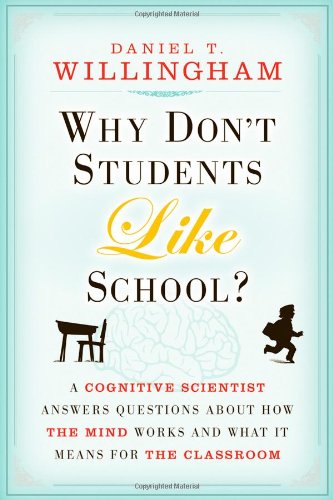
Book Review - Why Don't Students Like School by Daniel T. Willingham


Willingham has written a thoughtful and insightful book about cognitive science. He describes current understanding of how the mind works and the possible impact of this research on life in schools and classrooms. 

"The mind is at last yielding its secret to persistent scientific investigation. We have learned more about how the mind works in the last twenty-five years than we did in the previous twenty-five hundred."

The main findings from this book indicate the importance of factual knowledge to children's development, "thinking well requires known facts".  Willingham discusses the importance of working memory and uses the imagery of allocated slots. It is important not to overburden the working memory. To achieve this, teachers need to organise deliberate practice for their students. This must be maintained over time and can be folded into more advanced skills. This moves knowledge from working memory to long term memory and avoids overload by becoming automatic (e.g.like driving a car).

I agree with the important message though that drives through this book, that we should make students think deeply, but in order to achieve this, shallow learning and practice is sometimes needed. Unfortunately in recent times in the UK this has been ignored in pursuit of fluff, show lessons that are thought to impress OFSTED, but do not aid the overall development of students and often distract students from thinking about what they are supposed to. Practise automatices knowledge from working memory to long term memory and allows the brain to work more efficiently and fluidly. The idea of conceptual understanding is not rubbished but he promotes a balanced approach between procedural and conceptual development. Connections between topics and previous learning are also important because they reduce the stress on working memory and develop proficiency. 

The ideas of hooks are also promoted. Interestingly, it is suggested to try these in the middle of the lesson rather than the usual start or end. Hooks are very useful in allowing the brain to make connections and help to develop a deeper understanding of topics.

He states we should, "strive for deep understanding in your students, not the creation of new knowledge" (that will come later). The vast majority of top mathematicians, scientists etc. have got there because they have developed core knowledge and then have worked hard to excel in their particular field. I have also considered it strange how some of the highest academics criticise the path to how they have excelled. It is like a walker crossing a log on a fast moving stream and then kicking it away so others cannot cross in the same way. This is an important message and one that slightly differs from other books I have read - particularly in the field of maths education, where the message is to try to get students to think like elite mathematicians. Often this has happened through the promotion of calculators or more recently WolframAlpha as a substitute for basic knowledge. Although these products are useful, ignoring the basics does not benefit students in the long term. Again it is important to emphasise, higher order thinking is important but must not be done at the expense of basic skills that underpin subjects.

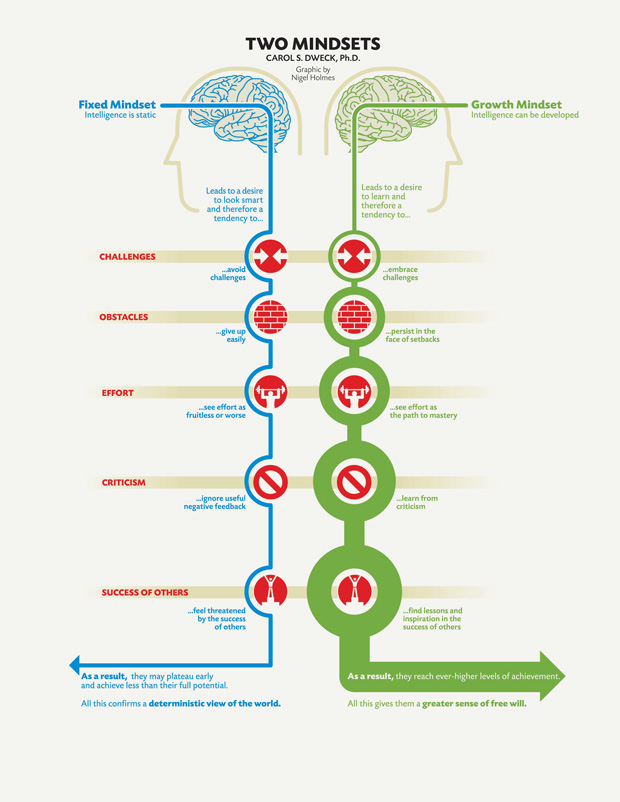
Willingham's chapter about intelligence is very similar to the work completed by Dweck. (See previous post about Grit and a Growth Mindset). Intelligence although partly dependent on genetics and environment is not fixed. "Intelligence can be changed through sustained hard work". This message is extremely important to us as educators. For if it was fixed what would be the point of education? This has particular resonance in mathematics in the Western World where often there is a stigma around the subject and people strongly believe they simply cannot do it because of some inherited fault. Willingham highlights the folly of this idea and with hard work everyone can improve.

Willingham's last chapter focuses on teacher development. He believes teachers need to deliberately practice to improve. He provides a comprehensive approach to this using video, teacher feedback and other ideas. I liked the simplicity of an idea earlier in the book where two skills of teaching were highlighted: organisation and relationships. I look forward to trying out some of these ideas in the new academic year.

At the heart of teaching is to try to make students think. This book provides powerful insight in how to achieve this.

Wednesday, 9 July 2014

Reading List for New Maths Teacher

I was asked recently what I thought would be a suitable reading list for a new UK Maths teacher. Below is my list. Have I missed anything out?

General Teaching:

  • "Teach Like a Champion", Doug Lemov 
  • "Mindset", Carol Dweck 
  • "Why Don’t Students Like School", Daniel T Willingham 
  • "An Ethic of Excellence", Ron Berger 
  • "The Hidden Lives of Learners", Graham Nuthall 
  • "Visible Learning and the Science of How We Learn", John Hattie 
  • "100 Ideas for Secondary Teachers", Ross Morrison-McGill 
  • "Teacher’s Tookit", Paul Ginnis 
  • "Trivium 21C", Martin Robinson 
  • "Adapt", Tim Harford 
  • "The Secret of Literacy", David Didau 
  • "The Behaviour Guru", Tom Bennett 
  • "How to Teach", Phil Beadle 
  • "The Perfect (Ofsted) Lesson", Ian Gilbert 
  • "Teacher Proof", Tom Bennett 
  • "Getting the Buggers to Behave", Sue Cowley
  • "The Lazy Teacher's Handbook", Jim Smith
  • "How Children Learn", John Holt
Shaun Allison has created an excellent CPD video library


Mathematics:

  • "The Elephant in the Classroom", Jo Boaler 
  • "Alex’s Adventures in Numberland", Alex Bellos 
  • "Taming the Infinite", Ian Stewart 
  • "Murderous Maths" series by Kjartan Poskitt
  • "The Perfect Maths Lesson", Ian Loynd
  • "Adapting and Extending Secondary Mathematics Activites", Stephanie Prestage & Pat Perks 
  • Collection of Professional Development Materials for Maths Teachers by Mark McCourt at Emaths
  • Cockcroft Report 1982 
  • "Getting the Buggers to Add Up", Mike Ollerton
  • "Key Ideas in Teaching Maths - Research-based Guidelines for ages 9-19", Anne Watson, Keith Jones, Dave Pratt
  • "Nix the Tricks", Tina Cardone and MTBoS
  • "How Children Learn Mathematics", Pamela Liebeck
  • Collection of Publications by Professor Malcolm Swan
  • "Children Discover Arithmetic", Catherine Stern
  • "Understanding Mathematics for Young Children", Derek Haylock
  • "1089 and All That", David Acheson
  • Debates in Mathematics Education, edited by Dawn Leslie and Heather Mendick, for the more reflective practitioner

Saturday, 5 July 2014

Collaborative/Cooperative Learning

"Collaborative or cooperative learning can be defined as learning tasks or activities where students work together in a group small enough for everyone to participate on a collective task that has been clearly assigned. This can be either a joint task where group members do different aspects of the task but contribute to a common overall outcome, or a shared task where group members work together throughout the activity. Some collaborative learning approaches also get mixed ability teams or groups to work in competition with each other, in order to drive more effective collaboration."
(Education Endowment Foundation)

My Practice

This year, I have begun to develop my practice specifically towards cooperative learning. In my classroom, students work together in small 'pods' (3 or 4 students) where the goal is to help and support each other to develop their learning and understanding.


Within each pod, I try to mix gender, ability and other factors. When needed, students have changed pods during the year. For a small minority students, it has been more of a challenge to settle them to work collaboratively within a pod and to find the most effective pod for them to work in. I have found older students are more likely to create a stable and effective pod which stays in tact for the whole year. I would suggest this is probably because their friendships with other students is more secure. Younger students are generally happy to work within pods, but these have to be altered more frequently throughout the year to achieve balance and harmony within the class.

I have not imposed a competitive element into my system yet. I am considering it carefully for next year and I'm thinking of trialing it with my KS3 classes (11-14). I am aware of the importance of getting this right so will need to do more research over the next couple of months.

I actively encourage students to work closely within their pods. Specific tasks are created to encourage discussion within the pod. When an individual seeks help from me, I tend to talk and involve the pod as a group, thus encouraging them to work and think as a team. This often ensures quieter members of the pod also get support. On this note, both introvert and extrovert students seem to work well within this system and neither type dominates. I encourage higher ability members to support their pod with explicit praise, both verbal and written.

Evidence

"Evidence about the benefits of collaborative learning has been found consistently for over 40 years and a number of research studies have been completed. In addition to direct evidence from research into collaborative learning approaches, there is also indirect evidence where collaboration has been shown to the effectiveness of other approaches such as mastery learning or digital technology. It appears to work well for all ages if activities are suitably structured for learners’ capabilities and positive evidence has been found across the curriculum."
(Education Endowment Foundation)

Reflections

Collaborative/Cooperative learning has helped to develop a positive atmosphere within my classroom. I have found the vast majority of students work well within the pods and this has helped to develop independent learning skills as they tend to ask each other first and only ask me if confusion or uncertainty remains. To help students, I move between pods, rather than individuals, which is more time-effective. This strategy seems to work very naturally with Mathematics.

For more information:

Sunday, 15 June 2014

La Salle's National Mathematics Conference

La Salle's National Mathematics Conference for Secondary and Primary Teachers, Kettering Saturday 14/6/14 - Sponsored by AQA 
#mathsconf2014

My Notes and Reflections

Mark McCourt - Chief Executive, La Salle Education

Mark introduced La Salle's new mathematics product, Complete Mathematics. This provides complete support for mathematics teachers by providing them with help with planning and assessment. I look forward to investigating this in more detail in the next couple of weeks.


Keynote speaker, Dr Vanessa Pittard, Assistant Director, Curriculum and Standards, DFE

Dr Pittard began her talk with an analysis of the PISA results for Mathematics in the UK. (Key findings for the UK). English students are good at data and number, but need to focus on shape and space, and problem solving. Not sure why then, the weighting of Geometry in the New GCSE is reduced? 

Dr Pittard moved on to discussing the new Maths Curriculum and how it is benchmarked against high-performing jurisdictions like Singapore and Massachusetts. The new A-level Mathematics will be introduced in 2016, along with the Core Mathematics qualification for post-16.


The New GCSE - Andrew Taylor AQA

Andrew Taylor provided a comprehensive introduction to the new Maths GCSE and gave an overview not just from AQA but all the exam boards.

The GCSE will be writtten papers only. Exams will be linear and summer exams for all. November entry is only available for post-16.

The papers will be 4 1/2 hours long and split 1/3 to 1/2 between calculator and non-calculator papers. Foundation Tier and Higher Tier remain (no return to the intermediate tier). Grades are from 1-9 (9 being the highest). Foundation Tier 1-5 and Higher Tier 4-9 (there is a safety net grade 3 on the higher-tier).

The Mathematics GCSE will carry a double weighting in the new accountability measures. (See Factsheet on Progress 8). Andrew described the new GCSE as a "Maths GCSE on steroids".

AQA have split the time allocation into 3 papers each 90 minutes long. The first paper in a non-calculator and the other two are calculator exams.

The big news about content is there is a large shift towards Ratio, Proportion and Change (largely at the expense of Geometry and Measure), which a number of people in the audience felt aggrieved about. Both the Higher Tier and the Foundation Tier will be skewed more towards the top grades than currently.

More information see Craig Barton's blog


Assessing Without Levels - David Thomas and Alan Gothard (both from Westminster Academy)

Westminster Academy's mathematics curriculum has beed designed around three principles:
  1. Break the curriculum down
  2. Define it with questions
  3. Use Analogue Data
The curriculum is split into discrete topics e.g. adding and subtracting decimals. Per year, there are 15-20 topics and each one is assessed individually. For clarity, the topics are defined with questions from three categories: Use & Apply, Reason, Interpret and Communicate, and Solve Problems.

Data is used to create an Assessment for Learning rather than an Assessment of Learning model. Rather than an approach of can they do this? Yes or No, analogue data is used (a percentage score) so it is easier to define the students level of mastery. Data is collected and weighted from small quizzes (40%), homework (20%) and end of term tests (40%). This leads to clear reporting to parents of what their child's strengths and weaknesses are topic by topic. 

The main advantages of this system is that it can highlight when an individual student's performance drops or when a member of staff might need support with teaching a particular topic.

What I liked about this system is the simplicity and clarity it provides to students, parents and teachers. It is far more practical to report on how a students is progressing in particular topics though out the year, rather than focusing on meaningless sub-levels.

For more information, read "Assessing Without Levels" blog by David Thomas including presentation given at Conference.


Blindingly Obvious - Bruno Reddy, King Solomon Academy

Bruno's work is highly influenced by the Cognitive Scientist, Daniel T. Willingham (author of "Why Don't Students Like School?"). Why do pupils get stuck? Their working memory runs out of space. On average, people can have 7 working memory slots. However, some students may only have 4 and three of these might be taken up with listening/speaking, writing and remembering.. It is therefore important to reduce the amount of pressure on the brain.

King Solomon Academy focuses on mathematics. Students receive between 6 and 7 1/2 hours per week of lessons on mathematics. Classes are taught as mixed ability form groups and it is the teacher which moves classroom rather than students, to reduce transition time.

The curriculum focuses on longer studying fewer things. In year 7 in particular, a lot of time is focused on the foundations of maths, number and place value. Some of the more complex areas of the KS3 curriculum and left until KS4. Similar, but confusing, concepts are separated e.g. area and perimeter or median, mean and mode. 

Blindingly Obvious refers to how they approach lesson planning. The pitfalls of modern day maths textbooks and worksheets are highlighted. 
  1. Minimally Different Examples - questions where just one variable changes. 
  2. Trickle Feeding - a little bit of the same every day.
  3. Building Automaticity - practising the basics until perfect.
  4. Splitting the Steps - and practice each in turn
  5. Take the first step last
Bruno introduced his product, Times Tables Rock Stars


A challenge was also laid down to beat the KSA's World Record for the largest number of people rolling numbers


For more information see Mathematics Mastery.
My personal reflections - this was a fantastic day. Managed to get up to speed in latest developments in the Mathematics Curriculum. Listened to inspirational Maths teachers, Bruno Reddy, David Thomas and Alan Gothard. Finally, got to meet some amazing people and put names to twitter handles - El_Timbre, MakeMathsMatter, Just_Maths, Ms_Kmp and missradders. My only regret is I couldn't see the other speakers. Wow. What a fantastic day. 

Thank you MarkLa Salle and AQA.

PS Cakes were amazing!!!!

Wednesday, 11 June 2014

Book Review - Adapt by Tim Harford


A review of Adapt by Tim Harford and how it can be "adapted" for the world of education. (Inspired to read and reflect about this book after it was recommended by John Tomsett at NTEN ResearchED York).

Tim Harford composes a clear and structured argument on the importance of adapting, not just from an ecological point of view but as individuals, companies and other organisations. Mistakes are commonplace and inevitable. Harford uses a number of case studies from the development of the Spitfire, changing tactics in Iraq, the Credit Crunch to modern companies such as Google to explain and demonstrate the importance of adapting and the problems that emerge when this doesn't take place.

Harford draws deeply on the three Peter Palchinsky Principles:
  1. Seek out new ideas and try new things
  2. When trying out new things, do it on a scale that is survivable
  3. Seek out feedback and learn from your mistakes
What is intriguing about this book is how Harford unravels the mystery of adaption by highlighting the traps and promoting the benefits of adapting.

Barriers to learning from mistakes include: bundling losses up with gains, reinterpreting failures as successes, denial and loss chasing. To counteract this, Harford perscribes working by the Palchinsky Principles. We need to listen, whether this is as a company to whistleblowers or as individuals to what is described as the "validation squad" of trusted individuals who will give us their honest opinions. Change needs to be completed on a scale that promotes reflection and honesty.

Why adapt? 

"The process of correcting the mistakes can be more liberating than the mistakes themselves are crushing, even though at the time we so often feel the reverse is true". Mistakes in life are inevitable. However, "a single experiment that succeeds can transform our lives for the better in a way that a failed experiment will not transform them for the worse - as long as we don't engage in denial or chase our losses".

What are the implications for teaching?

In teaching, there is a constant need to adapt and change. In the classroom, what works one moment can fail disastrously the next. Teenagers can sometimes be a little volatile. However, how do we know we are doing the right thing and not just bumbling along? One of the most important principles mentioned is listening - whether this is to a trusted colleague or a sensible student. 

Education is bombarded with new ideas and the hunt for the pot of gold at the end of the rainbow. The difficulty is sifting and finding the sensible ideas - the ones which benefit students and make the lives of teachers easier. Harford promotes the importance of trying out new ideas. However, this needs to be done in a controlled way and not gun-ho, devil-may-care and by the seat of the pants. Adaption needs to be on a scale where success can be measured. Allowing ourselves times to reflect and most importantly, to listen to the opinions of those we trust. By investing on a modest scale, the traps of chasing losses and denial are more likely to be avoided. 

The Palchinsky Principles should be above the door of every staffroom.

For Students:

Students need to be encouraged to try new things and to accept mistakes as a part of life. This links to a previous blog by me, Developing Grit and a Growth Mindset.

I really enjoyed this book. It has made me reflect on the implications adaption has on my life and the wider world around me.

Saturday, 7 June 2014

Book Review - "The Hidden Lives of Learners" by Graham Nuthall


I bought this book after hearing a number of very positive comments about it at NTEN ResearchED York.

Graham Nuthall's book "The Hidden Lives of Learners" is a study of learning from a student's point of view. It focuses on the highly influential world of peers, and the student's own private world and experiences. Nuthall has used a comprehensive array of research tools and collected data over forty years, bring this all together in this one book. What becomes clear is that just because a teaching, does not mean students are learning.

"Learning requires motivation, but motivation does not necessarily lead to learning."

Nuthall's book provides a simple check list to effective teaching. The book discusses memory in detail. He slams learning styles (e.g. VAK) and states to build memory, students need to make connections with new knowledge and known concepts. For knowledge to be retained students need "several different interactions with relevant content for that content to be processed int their working memory and integrated into their long-term memory in such a way that it becomes part of their knowledge and beliefs."

Assessment is a tricky topic. He sees the best strategy for assessment is for it to be "conducted individual by individual, and embedded in a programme that fully considers individual preferences." This has obvious difficulties from a time management point of view, but one that we as educators need to consider and think carefully about.

The one area I was not completely convinced by was his idea of "becoming involved in peer culture" and in fairness, Nuthall too was reserved about this idea. I understand the advantages of knowing your students, but I also consider it to be healthy for their to be a little professional distance in the teacher/student relationship (especially in the age category I teach 11-18).

For me personally, I like to strive for the optimum seating arrangements in my class to develop co-operative learning. I think about peer groups but the driving force is finding which individual students work well with who.  I try to create pods of 3 or 4 students (preferably of varying ability and other factors). Most importantly, I look at my assessment results and if I believe a pod is not working effectively, I look to change it.

I prefer the "alternative culture" within the classroom by creating a "learning community". A complex idea but, in my opinion, this should be at the heart of any school and run through it like a river.

I was particularly interested in the strong evidence shown for the effects of students managing their own learning. This ideas seem to run alongside ideas of a Growth Mindset, grit and determination, and developing independent learning. I try hard in my teaching of mathematics to open this door, by using Mymaths,  Hegarty Maths, or BBC Bitesize. I also like to stretch their knowledge and understanding by looking at advanced material e.g. Numberphile or Vi Hart.

For more information, visit The Graham Nuthall Classroom Research Trust website.

Sunday, 25 May 2014

Developing Grit and a Growth Mindset


"Grit is passion and perseverance for very long term goals. Grit is having stamina. Grit is sticking with your future... and working really hard to make it a reality." Duckworth

source: patheos.com

But how do I build Grit in students? Duckworth suggests developing a Growth Mindset (Dweck) and make them understand it is okay to fail. Dweck talks about the brain 'growing' or making connections when misconceptions are corrected (with a Growth Mindset).


Teaching strategies I have used this year:

Model this myself - when I make a mistake and a student notices and corrects me, I award them a house point and thank them for pointing it out to me. This can often lead to a quick discussion about checking answers etc.

Use incorrect answers - when a pupil makes a mistake I use positive curiosity. I get them to explain their mistake and then talk about how useful or interesting their mistake was for the rest of the class and for me. Mistakes are fine as long as we learn from them.

Pause -  I've tried very hard to make sure I give pupils time to think about their answers. With some their may be an awkward long silence (eventually they do provide an answer). If they require prompting, I try to give them the minimum possible prompt. I never let them get away with not answering and sometimes ask them to simply make an educated guess. I have found this to be a very effective strategy to keep all engaged and raise expectations of all pupils.

Poor test result - discuss with class/pupil the correct response to a bad result immediately after being given it. E.g. rather than getting frustrated and wanting to tear it to pieces, write corrections and use it to help development and chat with me at the end of the lesson if you still don't understand.


Life isn't easy - if it was it would be very dull. Imagine you got everything your own way. Every shot on goal you scored. You could instantly play any instrument perfectly. You knew everything. Where's the challenge? Where's the fun in that? My subject, mathematics, is hard, but that's the challenge, that's the fun. I explain to my class that I enjoy doing puzzles (e.g. Sudoku) in my spare time. I also love really hard maths questions and explain how, last week, with a particular A-level question I was stuck on it for a couple of hours. The longest I've spent mulling over a particular problem is several weeks or even months. Warning - some minds are blown at this stage!

I have no evidence to suggest any of the above strategies actually work. However, if we want pupils to have grit, determination and a growth mindset - I believe the most important thing we can do is model this behaviour ourselves and make this explicit to the children we teach.

Read more about this on this excellent blog by Joe Kirby, "Motivation and Mindset Anchoring". "This much I know about... developing a Dweck-inspired mindset culture" by John Tomsett. Interesting reflective blog by Stephen Tierney, "Growth Mindset: The Latest Silver Bullet". Finally, a balanced argument from David Didau, "Grit and Growth: who's to blame for low achievement?"


Tuesday, 13 May 2014

NTEN ResearchED York 2014 #NTENRED


“Every teacher needs to improve, not because they are not good enough, but because they can be even better.” Dylan Wiliam

ResearchED is a growing movement in education with its roots within the UK education Twitter community. It was established last year by Ben Goldacre (Author of Bad Science @bengoldacre) and Tom Bennett (Teacher/TES @tombennett71) and is for educators, researchers and anyone interested in evidence-based education. From this, groups such as Teacher Development Trust, NTEN and the Headteachers Roundtable have established themselves.

On Saturday, 3rd May I made the trip to Huntington School, York for my first ResearchED conference (cost of ticket £13), joining nearly 300 eager people. The biggest decision which needs to be made when attending a ResearchED conference is who to see. Yes, you get a choice! All speakers had given up their time for free and are regular bloggers so you have an understanding of them and their views before the event.

The keynote speaker was John Tomsett (@johntomsett). John is Headteacher of Huntington School and a member of the Headteacher’s Roundtable. John talked about removing the culture of fear (observations and judgements) and moving towards a model of coaching and using questions such as ‘How best can I observe you to improve your practice?’. He discussed using HQ video and sound to observe yourself. Underpinning everything is creating a learning community throughout the whole school and the pursuit of excellence. 

If you haven’t read it, you should:

Mary Myatt (an OFSTED inspector to admire @marymyatt) and David Weston (Chief Exec, NTEN & Teacher Development Trust @informed_edu) spoke about introducing research into schools at a micro level. Mary divulged the characteristics of research schools: energy, openness, enthusiasm, enjoyment and collaboration (more in her blog). David introduced the idea of 'Lesson Study' as a model for research in schools (see more on NTEN website)

‘Too many teachers waste time looking for the magic bullet’, John Hattie

ResearchED doesn’t believe it is the magic bullet but believes through research, study, collaboration and a bit of hard work we can create a superb educational structure within the UK. 

Mark McCourt (Chairman, Teacher Development Trust @EmathsUK) discussed building education from the ground up and asked us to consider ‘What is knowledge?’, ‘What is the purpose of education?’ and ‘What is the best model for education?’.

Martin Robinson (author of Trivium 21C @surrealanarchy) smoothly lectured on achieving balance in the curriculum between grammar, dialectic and rhetoric. If you haven’t read his book, it is fantastic - explaining the history of education and what he believes to be its ideal structure. (Recent article by Martin in the TES and blog "Engaging with a Humane Education")

Tom Bennett ranted entertainingly about psuedo-science in education and his particular bug-bears of Braingym, NLP (which I hadn’t heard of) and VAK. Have you rubbed your brain buttons recently? There is an obvious need for schools to work closely with researchers to find the best and most reliable evidence out there. (Read his article in the TES here)

Finally, Alex Quigley (Deputy Head at Huntington School @huntingenglish) spoke eloquently about his own research and his seven steps for a great explanation - gesture, connecting prior knowledge, visual cues, metaphor, making it concrete, storytelling and repetition. (Alex's blog on #NTENRED)

ResearchED was truly inspirational. I left with the feeling I needed to read more but with the satisfaction I was on a learning journey with everyone else. No one at the conference believed they knew everything (which is different from the usual imported ‘experts’ that spout their opinions at school CPD and cost a fortune to do so).  

My personal reading list includes, Graham Nuthall’s ‘The Hidden Lives of Learners’, Tim Harford’s ‘Adapt’ and Ben Golacre’s “Bad Science’.

If you missed it, here are some videos

Dafydd Collins (@mrdgcollins)

                                              Sunny day in York