Landscape

Thursday, 4 December 2014

Khan Academy


I used Khan Academy for the first time with one of my teaching groups today. I have previously explored Khan Academy, from a student's point of view, trying out different tasks etc (I would strongly advise you do this before hand) and felt the time was now right to become a 'coach' and investigate its usefulness within the classroom. 

The group I chose was a GCSE retake group. I had managed to permanently book an IT room for once a week with this group and this made an opportune moment to experiment. I was pleasantly surprised how well the lesson went. It was very easy to set up a Khan Academy Classroom. I had already established a Google Classroom, so I highlighted every student and clicked to email them, then copied their email addresses and pasted this into Khan Academy. It took a couple of minutes to create a classroom and then for students to join by clicking the link sent to them via email.. 

I didn't set up any particular tasks or missions but invited the class to focus on the foundation area of Mathematics. With little instruction, students were quickly able to complete tasks. They became motivated by the points and awards. Soon this became competitive with some students. All students engaged and were on task. Students began asking for help when needed - I haven't yet started emphasising the online video support, but will start doing that from next lesson. Some students who had been less motivated suddenly started working very well. The class lost track of time and worked into their break time and at the end of the day, a student emailed to see if he was number one (as he had been working on tasks during his lunchtime). I will see if this level of enthusiasm persists. Students seem to enjoy not only the competitive side but the independence Khan Academy gave them.

The data on students and classes is very useful. Progress of the class is easily monitored time and this can be varied. Putting a leader-board on the interactive whiteboard inspired some students to be competitive - students worked hard to be at the top and to avoid the bottom place. Individual data was also useful to see where students were struggling and also what they were able to do. Generally, I think students found it motivating that they were able to complete easier tasks, but this will need to be monitored to ensure they can complete more complex tasks needed for their examinations.

My next step is to create a playlist of topics that will be suitable for my students and enable me to focus their attention on particular units. I have quickly set up Khan Academy Classrooms for my other groups, but are not planning to use it within the classroom, but to encourage them to practise their maths skills in their own time. I will be curious to see how it will work in this context.

Khan Academy provides clear and comprehensive support for teachers to help them on this journey - Khan Academy Support Materials

Saturday, 15 November 2014

Book Review - The Chimp Paradox by Prof. Steve Peters


The Chimp Paradox provides the reader with a simple but effective model of how the brain works. Prof Steve Peters is a consultant psychiatrist who works in elite sport - notably with the very successful Sky Pro Cycling Team and Liverpool FC. He has received personal accolades from a long list of famous sports people such as Victoria Pembleton and Sir Chris Hoy (Olympic Gold Medallists), David Brailsford (Principal at Sky Pro Cycling Team), Steve Gerrard (England footballer) and Ronnie O'Sulllivan (Snooker player).

Peters is careful not to wrap himself as a guru but emphasises the science and research behind his model. He is not afraid to admit his model is a simplification of how the brain works. The book offers advice and exercises to improve the effectiveness of how your brain work, but the real power behind the book is explaining how yours and other people's brains work.


The model Peters uses is dominated by the Chimp and how to manage it. The brain is split into three personalities: the Chimp, the Human and the Computer. Put simply, the chimp represents our emotions and therefore it is important to understand not only how to manage our own chimps, but others.

From an education point of view, Peter's model could promote marginal gains within schools and students. It helps teachers empower their students to think constructively and productively, guiding them to become happy, confident and successful people (whilst avoiding being hijacked by their chimps). It provides a useful guide on how to interact with students, especially when their chimps are evident, which I have already found personally useful when dealing with potential conflict or emotional students.

I would highly recommend this book for anyone who wants to improve and have a better understanding of not only themselves, but those around them and the world we live in.

Saturday, 4 October 2014

Google Classroom - Month One.

This September, I have been using Google Classroom. The story so far...

Google Classroom is very easy to use. It was relatively straightforward to invite students or get themselves to join the classroom and as they become used to the technology the process will become natural and simple.

I currently am a strong advocate of mymaths. It provides a comprehensive package for all school aged students. The user interface becomes more complicated post-16 and I use it less with A-level groups. However, for the majority of students it provides an efficient and straight forward method of completing homework. Firstly, you cannot lose it. Secondly, if you are stuck (including parents) it provides useful online lessons. Next, it marks work and provides instant feedback. Then crucially, it allows students to have further attempts (modifying the homework in the process). As a teacher, it provides me with spreadsheets which allow me to see how individual students/classes are performing on particular topics and links this with the old level descriptors and GCSE grades (soon to be old). This data can be easily used for report writing and for discussing with students and parents.

So why the need for Google Classroom. Currently, I am mostly using Google Classroom as a noticeboard. I use it to keep students up to date with current homework tasks and I use it to extend their current understanding and deepen their knowledge of mathematics by posting videos such as this from Dr James Grime:


I am currently experimenting with creating a questionnaire and then posting this on Google Classroom. I created a questionnaire to find out more information about the food students ate. Forms does not directly link to Classroom (yet). Although the Form, told me who had completed it, this was not then updated to the assignment on Google Classroom. I'm waiting for all the results to be in and looking forward to analysing the results. Update findings in next review of Google Classroom.


ResearchED National Conference London 6/9/14


The National ResearchED Conference this year was held at Raine's Foundation School,

The day began with an historical journey into education from when Raine's was established to the present day, by the present Headteacher, John Bradshaw. The difficulties faced over the years remain remarkably similar. Tom Bennett followed up, by trying to ignite a polite rebellion against top-down CPD and encouraging teachers to have a healthy relationship with research - cautious and curious.

One of the best things about ResearchED conferences is you get a choice of speakers (although this can lead to a bit of a headache deciding who to go to see). So first up, Dr Jonathan Sharples from The Education Endowment EEF. Jonathan talked about current research projects and advocated research champions within every school. He provided guidance on how to perform your own research:

1. Decide what you want to achieve
2. Identify possible solutions
3. Give it the best chance of success
4. Did it work?
5. Securing and spreading change.
And back to number one...


Next, the popular Dylan Wiliam (name spelt correctly!). Dylan's lecture was the provocatively titled, "Why teaching will never be a research-based profession and why that's a good thing". His first argument was that the cupboard was bare in relation to ed-research. He highlighted the difficulty of establishing causality and only lucky experiments get published (i.e. those who show a correlation, especially if it is the positive/negative result the author wished to see).

Following Dylan, I stayed in the beautiful old school hall to watch Prof. Robert Coe. Robert started with a cautionary note about offering teachers feedback after lesson observations. He emphasised, "What you think is good teaching may not be". Just because a certain way of teaching works for one person does not mean this can be transferred to another teacher, teaching a different class. Feedback to teachers must be:

  1. based on best evidence
  2. reflect diversity of teachers
  3. include protocols for demonstrating when they are met
To improve teaching a better understanding of evidence is needed that is based on research.

Phillipa Cordingly (CUREE) has researched exceptional schools in challenging circumstances and her compared them to other schools to try to discover why they are exceptional. Her comprehensive findings can be downloaded here.

Amanda Spielman (OFQUAL) provided useful insight and data into the examination process. She discusssed the pros and cons of the current examination system. People hugely underestimate variability in year-to-year exams. This can be as much as 12% in mathematics (which is generally straight forward to mark) and not surprising even higher other subjects (e.g. English 15%). This means OFSTED, Governors, Headteachers etc. need to be very cautious when analsying results as a sudden rise/fall may be down to natural variation and nothing to do with latest interventions.  When we look on an individual student basis, about 23% of students won't be allocated the correct grade (usually a grade either side).


More information about other talks and blogs about the conference can be found here:

Tuesday, 26 August 2014

Google Classroom

I'm excited about using Google Classroom. The design is simplistic and easy to use, providing quick access to particular classes. I like how it automatically creates assignment/class folders within google drive. The announcement section looks promising as a way of developing teacher/student dialogue (particularly useful for quieter students). Can't wait to try this out in September...


Promotional video by Google


Google Classroom Teacher and Student View by +Roger Nixon

Google Classroom Community on Google+


Friday, 8 August 2014

Book Review - Bad Science by Ben Goldacre


This is a fascinating book into the world of research and statistics. Goldacre looks at topics including Homeopathy, MMR Vaccines and Drug Companies and investigates the flawed medical trials and the problems with media interpretation. For teachers, there is also a section on the folly of Brain Gym.

As a Maths teacher, the book is extremely useful becuase it provides great insight in to modern techniques and how to correctly carry out Medical trials and Research, by often highlighting misleading methods and statistics. It looks in details at topics such as blind testing, regression to the mean, placebo effects, etc. This book would be particularly useful to run with the new Core maths qualification at post 16.

I would highly recommend this book to not just maths and science teachers, but to everyone within education. It highlights the need for a solid research base in education and the need for greater knowledge in this area. Fads, like Brain Gym, not only damage the education of our students but are a huge waste of money and resources.

See more at badscience.net and section for teachers.

For more on Educational Research see - EEF (UK) or WWC (US)

Thursday, 7 August 2014

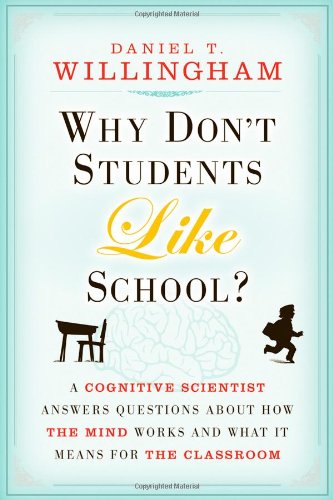
Book Review - Why Don't Students Like School by Daniel T. Willingham


Willingham has written a thoughtful and insightful book about cognitive science. He describes current understanding of how the mind works and the possible impact of this research on life in schools and classrooms. 

"The mind is at last yielding its secret to persistent scientific investigation. We have learned more about how the mind works in the last twenty-five years than we did in the previous twenty-five hundred."

The main findings from this book indicate the importance of factual knowledge to children's development, "thinking well requires known facts".  Willingham discusses the importance of working memory and uses the imagery of allocated slots. It is important not to overburden the working memory. To achieve this, teachers need to organise deliberate practice for their students. This must be maintained over time and can be folded into more advanced skills. This moves knowledge from working memory to long term memory and avoids overload by becoming automatic (e.g.like driving a car).

I agree with the important message though that drives through this book, that we should make students think deeply, but in order to achieve this, shallow learning and practice is sometimes needed. Unfortunately in recent times in the UK this has been ignored in pursuit of fluff, show lessons that are thought to impress OFSTED, but do not aid the overall development of students and often distract students from thinking about what they are supposed to. Practise automatices knowledge from working memory to long term memory and allows the brain to work more efficiently and fluidly. The idea of conceptual understanding is not rubbished but he promotes a balanced approach between procedural and conceptual development. Connections between topics and previous learning are also important because they reduce the stress on working memory and develop proficiency. 

The ideas of hooks are also promoted. Interestingly, it is suggested to try these in the middle of the lesson rather than the usual start or end. Hooks are very useful in allowing the brain to make connections and help to develop a deeper understanding of topics.

He states we should, "strive for deep understanding in your students, not the creation of new knowledge" (that will come later). The vast majority of top mathematicians, scientists etc. have got there because they have developed core knowledge and then have worked hard to excel in their particular field. I have also considered it strange how some of the highest academics criticise the path to how they have excelled. It is like a walker crossing a log on a fast moving stream and then kicking it away so others cannot cross in the same way. This is an important message and one that slightly differs from other books I have read - particularly in the field of maths education, where the message is to try to get students to think like elite mathematicians. Often this has happened through the promotion of calculators or more recently WolframAlpha as a substitute for basic knowledge. Although these products are useful, ignoring the basics does not benefit students in the long term. Again it is important to emphasise, higher order thinking is important but must not be done at the expense of basic skills that underpin subjects.

Willingham's chapter about intelligence is very similar to the work completed by Dweck. (See previous post about Grit and a Growth Mindset). Intelligence although partly dependent on genetics and environment is not fixed. "Intelligence can be changed through sustained hard work". This message is extremely important to us as educators. For if it was fixed what would be the point of education? This has particular resonance in mathematics in the Western World where often there is a stigma around the subject and people strongly believe they simply cannot do it because of some inherited fault. Willingham highlights the folly of this idea and with hard work everyone can improve.

Willingham's last chapter focuses on teacher development. He believes teachers need to deliberately practice to improve. He provides a comprehensive approach to this using video, teacher feedback and other ideas. I liked the simplicity of an idea earlier in the book where two skills of teaching were highlighted: organisation and relationships. I look forward to trying out some of these ideas in the new academic year.

At the heart of teaching is to try to make students think. This book provides powerful insight in how to achieve this.